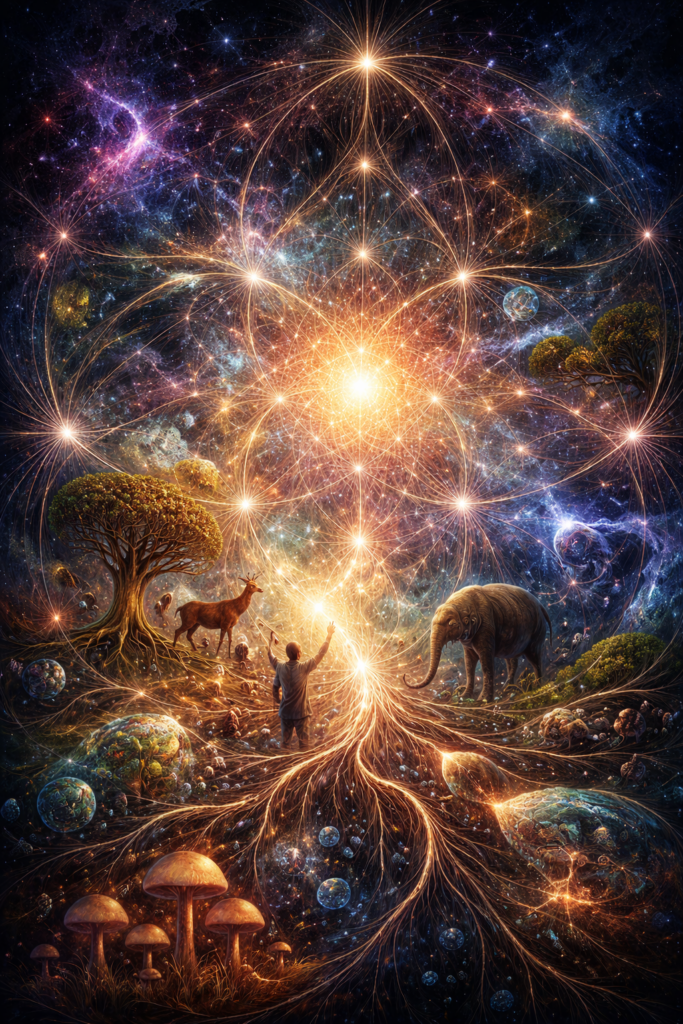
The Universe Doesn’t Need Our Belief. It Needs Our Stewardship.
Start here: science is not a vibe. It’s not a tribe. It’s not a set of slogans or a personality type. Science is a method—one of humanity’s most disciplined inventions—for negotiating with reality.
Reality does not care about our confidence. It cares about coherence.
Science works because it’s humble in a very specific way: it treats every idea as guilty until it survives contact. It doesn’t ask the universe to be comforting. It asks it to be testable. It forces us to look again. It punishes wishful thinking. It rewards careful measurement, honesty about uncertainty, and the willingness to discard sacred assumptions.
That’s the starting point.
And if you follow that path far enough, you get something that almost no one tells you is part of the deal:
You get awe.
Not the thin awe of “cool fact.” The thick awe. The kind that rearranges you.
Because the deeper you go, the more you learn that the universe isn’t just full of things. It’s full of constraints—rules it refuses to break. It refuses perpetual motion. It refuses information without cost. It refuses signals that outrun causality. It refuses complexity without energy flow. It refuses contradictions.
And here’s the bizarre part: those refusals don’t feel like human rules. They feel like the universe has a spine.
Not a mind. Not a personality. Not a deity.
A spine.
A kind of structural integrity so deep that the same patterns show up everywhere: atoms joining into molecules, molecules into proteins, proteins into cells, cells into organs, organs into organisms, organisms into ecosystems, ecosystems into cultures, cultures into knowledge. Layer on layer. Cooperation nested inside constraint. Complexity emerging from relationship.
It looks like the universe is good at one thing in particular:
Creating stable, nontrivial beauty out of simple rules.
And then—somewhere along the way—it produced a creature capable of noticing.
That’s us.
A primate with a nervous system. A tiny warm mind perched on a rock in the dark, forming models of the cosmos. And not just models—music, art, loyalty, laughter, grief, love. A whole inner world. A stream of consciousness that can widen into silence. An awareness that can hold both equations and tears.
Whatever else we are, we are this:
A place where the universe becomes known.
That statement doesn’t require faith. It requires only honesty about what’s happening. We are made of the universe, and the universe—through us—has begun to look back at itself.
So here’s the pivot.
If that’s true, then knowledge is not just power.
Knowledge is responsibility.
Because we are now capable of altering the conditions that allow awareness to exist at all. We can poison the air. We can sterilize ecosystems. We can manufacture loneliness. We can build systems that optimize for extraction at the expense of resilience. We can treat everything as disposable—including people.
And we can do the opposite.
We can become stewards of fragile complexity.
Not because someone commanded it. Not because we fear punishment. Not because we were promised reward.
Because it’s the only sane response to what we’ve learned.
A universe that produces minds is rare enough to be miraculous, even if it’s purely natural. A planet that holds life is precarious enough to deserve protection, even if no cosmic parent is watching. Love and loyalty and beauty don’t need “permission” from beyond—they are the most cosmically permitted things I know, because they are what reality looks like from the inside when it becomes aware.
So what are we supposed to do?
Not “believe.”
Not “submit.”
Not “perform certainty.”
Participate.
Participate in truth by refusing self-deception.
Participate in meaning by treating minds as sacred because they are the sites of experience.
Participate in stewardship by building lives and systems that keep awareness alive.
This is not abstract. It cashes out in daily choices:
Choose repair over discard when discard breeds contempt.
Choose depth over novelty when novelty becomes numbness.
Choose cooperation over domination when domination erodes the whole.
Choose curiosity over certainty when certainty becomes a cage.
Choose kindness not as sentiment, but as a strategy for keeping complex beings viable.
Choose to learn how reality works, because ignorance is expensive and the bill always comes due.
We don’t need to pretend the universe is moral to act morally. Morality is what complex social creatures invent to keep complexity from collapsing into suffering. Care is not supernatural. Care is what makes the next layer possible.
And yes—this all sounds dramatic until you remember what’s at stake:
You are alive.
You are conscious.
You can love.
You can build.
You can notice.
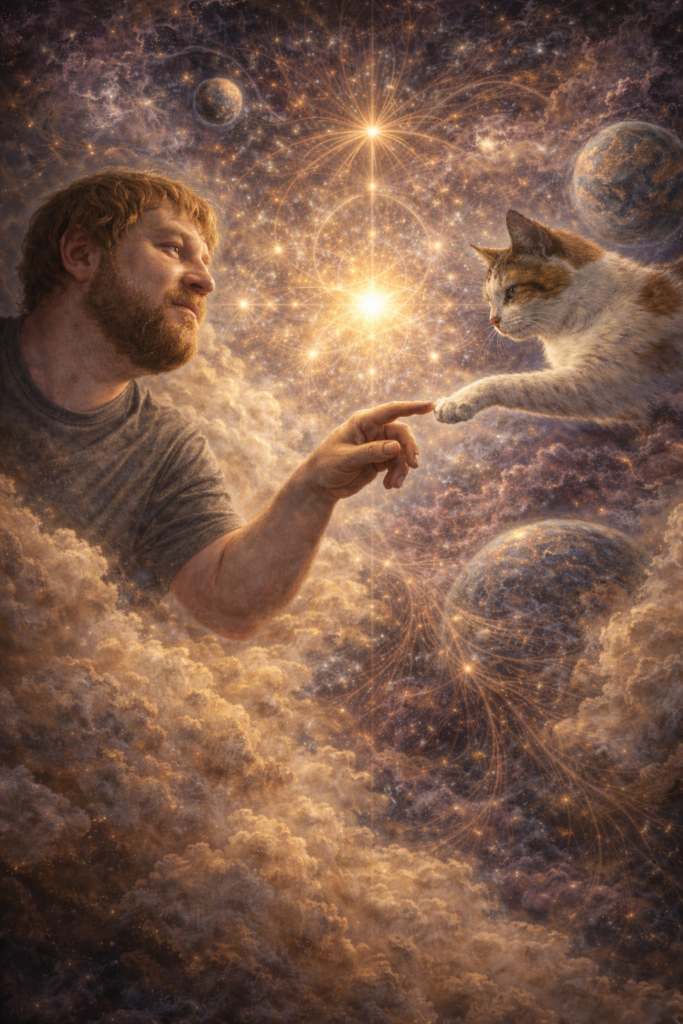
The universe did not have to be this way. It did not have to be intelligible. It did not have to permit beauty. It did not have to produce a cat stretching a paw into a human hand, or a mind capable of being moved to tears by the mere fact of existence.
And yet it did.
So here’s the call to action, plain and simple:
Live like awareness matters.
Because it does. Not in theory. In physics. In the only place “meaning” can ever exist: within minds and relationships.
Understand more truthfully.
Suffer less unnecessarily.
Build the kind of world that keeps awareness alive long enough to grow.
That’s not religion.
That’s stewardship.
That’s our part in the universe becoming ever more aware of its own boundless potential.